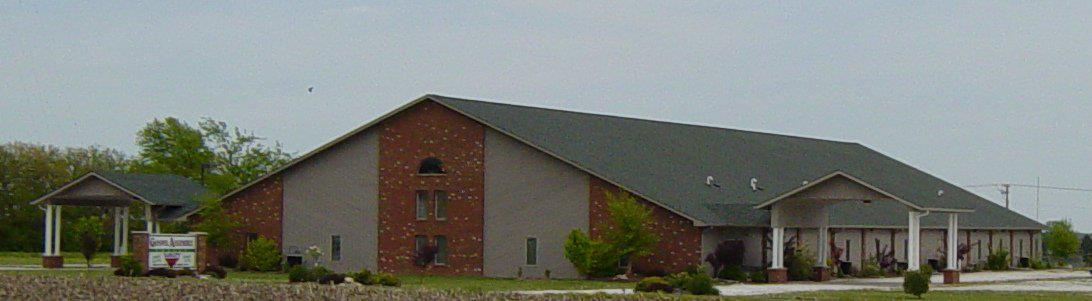
It is our privilege to invite you to a Minister’s Meeting to be held from October 22, 2024, through October 25, 2024. The meeting will begin Tuesday evening October 22 at 7 pm. There will be a meal served at 4 pm on Tuesday. Each day service will begin at 10:30 am and each evening service will begin at 7 pm. Friday’s service will be an open service and will begin at 11 am and close around 2 pm for Dinner. Each day a Continental Breakfast will be served at 8 am and Dinner will be served at 3 pm. Food and refreshments will be served following each evening service. Please contact Sis. Penny Booth at 618.946.3399 with all special dietary needs during the meeting.
A time of prayer, music sharing, and fellowship will be held for the Sisters on Tuesday evening at 7 pm. Women’s meeting will then be held at 10:30 am and 7 pm on Wednesday in the conference room. Thursday will be a free day for the sisters to dine, shop, and fellowship. If any sisters would like to go to Josephine’s Tea Room, you will need to call 618.466.7796 to make reservations. There will also be a women’s meeting held in the conference room at 7 pm on Thursday evening.
A limited number of RV spots will be available on a first-come first-served basis. Housing in our homes is minimal and most times arranged by each individual. A list of area Motels is included for your convenience. A list of miscellaneous numbers such as restaurants, stores, clinics, and hospitals is listed also.
It is getting late in the Gentile times and we need God to speak to us through his Ministry and prepare us for coming events. We are admonished in the Word of God to “earnestly contend for the faith which was once delivered unto the saints” (Jude 1:3). For many years now we have been faithful in coming together and contending for that faith. Thankfully, we have approached our contending with the imperative of “endeavoring to keep the unity of the Spirit in the bond of peace” (Ephesians 4:3). To a great extent, we have kept the unity of the Spirit in our midst and have made progress in the unity of the faith.
Now that we have come this far, Jerseyville Gospel Assembly Church humbly asks every man of God to come prayerfully seeking that which brought the glory of God on the Day of Pentecost and the inauguration of the Early Church. May we hear from heaven and receive guidance and clarity for our present and coming days.
The Jerseyville Church is approaching its 100th anniversary and hopes to provide an atmosphere filled with God’s Spirit and blessings. We look forward to being with you and are praying for your safe travel and comfortable stay. God bless you.
| Bro. Clyde Shaw | Bro. Sam Shaw | Bro. James Beck |
| 618-593-7301 | 618-420-9368 | 618-334-1833 |
| Transportation: | Bro. Daniel Lane 618-616-2252 |
| Lodging: | Most lodging in homes are reserved ahead of time by individuals, therefore lodging in homes is limited |
| Miscellaneous: | Wal Mart 1316 S State St Jerseyville, IL |
| Walgreens 705 S State St Jerseyville, IL | |
| Taco Bell – open until 11 pm 1400 S State St Jerseyville, IL | |
| JCH Walk-in Clinic (open 8 – 8) 903 S State St Jerseyville, IL | |
| Jerseyville Community Hospital 400 Maple Summit Rd Jerseyville, IL | |
| Some Alton, IL restaurants: | Panera Bread 1837 Homer M Adams Pkwy Alton, IL |
| Applebee’s 319 Homer M Adams Pkwy Alton, IL | |
| Hickory Grove Restaurant 201 E Center Dr Alton, IL | |
| Tony’s Steakhouse 102 W 9th St Alton, IL | |
| Josephine’s Tea room and Gift Shop 6109 Godfrey Rd Godfrey, IL | |
| Red Lobster 170 Homer M Adams Pkwy Alton, IL | |
| Josephine’s Tea Room and Gift Shop 6109 Godfrey Rd Godfrey, IL |
| Motels | |
|---|---|
| Super 8 – Jerseyville (Nice) 1303 IL-109 Jerseyville, IL 62052 888-478-5831 | Jerseyville Harvest Inn 730 S State St Jerseyville, IL 62052 618-498-6886 |
| Best Western 3559 College Ave Alton, IL 62002 618-462-1220 | Best Western Plus 1900 Homer M Adams Pkwy Alton, IL 62002 618-433-9900 |
| Hampton Inn (Very Nice) 1904 Homer M Adams Pkwy Alton, IL 62002 833-410-5737 | Holiday Inn Express & Suites 2008 Homer M Adams Pkwy Alton, IL 62002 888-465-4329 |